# Arkadiko 2.0 Documentation

All you need to know about Arkadiko's next iteration.

Welcome to the documentation of Arkadiko 2.0.

Arkadiko is a decentralized, non-custodial liquidity protocol where users can collateralize their assets and mint a stablecoin called USDA.&#x20;

Launched in October 2021, Arkadiko was the first Decentralized Finance protocol on Stacks, bringing native stablecoin liquidity to the on-chain ecosystem.&#x20;

Arkadiko 2.0 is the next-generation iteration of Arkadiko, introducing several improvements to the core protocol.&#x20;

Use the navigation bar on the left to read through the documentation. Make sure you understand everything before using the protocol. In case you have questions, find us in [Discord](https://discord.gg/GssXNkE5A4).&#x20;


# FAQ

## General

**Is it safe to invest money in Arkadiko?**

* Please do your own research and decide for yourself.&#x20;

**Is Arkadiko audited?**

* Arkadiko has been audited but you should move forward with care as no audit is catch-all guarantee.\
  Bugs or exploits could exist alongside the possibility of losing 100% of your invested funds.&#x20;

**Who runs Arkadiko?**

* No one. Arkadiko is DAO-governed. All decisions are formed by community members on the forum and made by token holders through snapshot voting.\
  There is a group of core-contributors that help maintain the infrastructure and code-base.&#x20;

## Feedback and Support

If you have questions or need help, we can assist you through the following channels:

* [Discord](https://discord.gg/gj6grzVthT)

If you have feedback or have found a bug, please refer to the following channels to make us aware:

* [Github](https://github.com/arkadiko-dao)

## Product

**What is an Arkadiko Vault?**

Arkadiko allows users to create a Vault. Users can deposit and withdraw assets into their Vault. Based upon the value of the assets locked in the Vault, a Vault Value is decided.&#x20;

Vault Value allows users to create an overcollateralized debt position. Currently, Arkadiko allows users to mint up to half of the Vault Value in USDA. The user takes on a debt in USDA and now has the responsibility to monitor the health of his vault (to avoid it becoming undercollateralized) and to repay back his USDA debt should he ever wish to regain access to his assets in the Vault.&#x20;

**What is USDA ?**

USDA is a stablecoin created by Arkadiko. USDA operates on a full reserve model. For every USDA in existence, there exist assets locked into Arkadiko Vaults such that the value of all assets in Arkadiko Vaults at all times eclipses the value of the total amount of USDA in existence. USDA is created when a users created USDA debt against collateral in an Arkadiko Vault. USDA is destroyed or burned when a user repays his debt in USDA.

**What is DIKO?**&#x20;

DIKO is the native protocol token of Arkadiko. It has the following uses:

1\) Users can stake their DIKO in the Security Module to receive stDIKO.

2\) Both DIKO and stDIKO holds voting power in the Governance process of Arkadiko.

3\) stDIKO holders receive periodic rewards based on ecosystem incentives.&#x20;

In general, DIKO serves as a coordination mechanism in the Arkadiko protocol.&#x20;

**When did Arkadiko launch?**

Arkadiko launched on November 22nd 2021.&#x20;

V2 of the protocol is scheduled for Q1 2024.&#x20;

**What is Arkadiko 2.0 ?**

Arkadiko 2.0 is the next iteration of the Arkadiko protocol.&#x20;

It introduces or plans to introduce several protocol enhancements such as:

1\) Redemption mechanism&#x20;

2\) Tokenomics upgrade&#x20;

3\) stSTX collateral

**What can I do to contribute?**

Depending on your skills and background, you can help us make Arkadiko a success. We can always use people that can contribute the following:

1. Be active in the community. Spread the word about Arkadiko and its internal workings so that everyone understands the protocol and is able to participate.
2. Collateralize your STX tokens in our vaults and use your newly gained USDA liquidity for yield farming opportunities.&#x20;
3. Build a protocol that incorporates either DIKO or USDA, giving them greater utility within the Stacks DeFi-ecosystem.


# Overview

Arkadiko is a decentralized, non-custodial liquidity protocol where users can collateralize their assets and mint a stablecoin called USDA.&#x20;

Arkadiko is a Decentralized Finance primitive which means it is a building block for other types of decentralized applications. The protocol is open-source, on-chain and permissionless.&#x20;

Arkadiko's core use case are Arkadiko Vaults, where collateral can be locked to mint a soft-pegged, dollar-denominated stablecoin called USDA. In order to make Vaults work, several mechanisms have been put in place to safeguard the overal health of the system.&#x20;

A [Liquidation Pool](/protocol/liquidation-pool) exists where anyone can deposit USDA on stand-by to be used when a Vault needs to be liquidated.&#x20;

A [Redemption](/protocol/redemptions) mechanism exists that allows anyone to exchange USDA for 1 USD worth of collateral in Vaults, minus redemption fees. This enables an arbitrage loop that keeps the peg healthy.&#x20;

[Arkadiko Swap](/protocol/swap) exists as a primitive AMM for USDA-denominated pairs. Its main liquidity pairs are STX/USDA and DIKO/USDA. The LP tokens from the Swap can be [staked](/protocol/stake) to receive a share of DIKO emissions.&#x20;

DIKO is the native governance token of Arkadiko. Its primary purpose is to create or vote in DAO proposals.&#x20;

The following diagram shows the different types of functionality and tokens within the  Arkadiko ecosystem:

<figure><img src="/files/c5WVcn4fZq8VWdzp6ovJ" alt=""><figcaption></figcaption></figure>

USDA is extra liquidity which can be used within the Stacks DeFi ecosystem. \
Some potential uses of USDA:

1\) Swap USDA in USDA-denominated liquidity pools to another token, such as more STX.

2\) Provide liquidity to asset pools on a Decentralized Exchange or Automated Market Maker. Earn trading fees from swaps that occur within the pool.

3\) Deploy USDA into various liquidity mining farms. Tokens from other protocols often launch by attracting liquidity and distributing tokens pro rata the liquidity provided.&#x20;

4\) Deposit USDA to a lending protocol on Stacks. Lender receives interest payments by borrowers

5\) Deposit USDA into an automatic liquidator for Arkadiko Vaults. Learn more in [Liquidation Pool](/protocol/liquidation-pool) .

In all cases, there is the opportunity to profit by owning USDA and putting it to productive use within the DeFi ecosystem on Stacks.&#x20;


# Vaults

secure smart contracts that hold your assets and allow you to mint USDA

Vaults are a key concept within the Arkadiko protocol.

A Stacks wallet user is able to interact with the Arkadiko protocol to open a Vault. He can then add collateral to his Vault, resulting in an amount of borrowing power based on the value of his collateral in the Vault. Based on this borrowing power and collateral value, the user can create a debt in USDA. As compensation for this debt, he receives a token called USDA, soft-pegged to 1 USD.&#x20;

We define the collateralisation ratio of a vault as *\<Vault Value> / \<Debt Value>* .

When the collateralisation ratio of a Vault dips below a certain treshold, the Vault's collateral is available for auction.  An integrated solution supporting liquidations and auctions is the [Liquidation Pool](/protocol/liquidation-pool).

<figure><img src="/files/pNY6YD0jCiY9nqnz3PTX" alt=""><figcaption></figcaption></figure>

**Collateral Types**&#x20;

A Vault is also defined by the asset it can contain. In Arkadiko V2, STX, stSTX and sBTC will be supported as collateral assets. \
\
Native Stacks tokens representing key protocols within the ecosystem can also be considered. Adding or removing a collateral asset is always contingent on a succesful governance vote.&#x20;

**Vault Parameters**

Next to the asset accepted by the Vault, there are other parameters to consider.

*Stability Fee*

The Stability Fee is expressed in a percentage and is the total cost of borrowing for a Vault. A Stability Fee of 1% means that any debt you create will increase by 1% over the period of one year. This percentage is added continuously over time to your debt. Think of the Stability Fee as yearly interest on your USDA loan.

*Liquidation Ratio*

Arkadiko Vaults work by over-collateralizing your STX tokens. This means there will always be more value locked within Vaults than there exists USDA debt. If your collateral decreases in price, the ratio between the value of your collateral and your debt decreases. It is key for the protocol to manage this ratio to ensure that Vaults remain over-collateralized at all times.&#x20;

Each Vault has set a liquidation ratio parameter. When *\<Vault Value> / \<Debt Value>* dips below the set liquidation ratio, the Vault becomes eligible for Auction. In short, this means that external Liquidators can come in and buy the collateral in your Vault at a discount, removing both your debt and the collateral from your possession. You will keep the minted USDA but your Vault and its debt are gone.&#x20;

It is an absolute necessity for everyone interacting with Arkadiko and creating Vaults that they closely monitor the Collateralization Ratio of their Vaults. We advise a 200%+ ratio at all times, to be safe during periods of high market volatility. Improving the health of your Vault can be done by&#x20;

1\) depositing additional collateral into the Vault, increasing *\<Vault Value>.*\
\
&#x20;or

&#x20;2\) repaying some of your USDA debt, decreasing *\<Debt Value>*.

*Liquidation Penalty*

This parameter comes into play when a Vault has been tagged for Auction and is liquidated by an external Liquidator. The Liquidation Penalty, currently set at 10%, is the loss of value you experience when a Liquidator needs to step in to clear your debt. This is also the discount at which the Liquidator is able to buy the collateral in the unhealthy Vault.&#x20;

Liquidation Price

The Liquidation Price listed on a collateralized Vault signals the price at which the Vault gets tagged for Auction. A Vault owner should assume that when his Vault is tagged for Auction, Liquidation will happen.

*Max Debt*

This is the total amount of USDA that can be minted for a certain Vault type.

*Current Debt*

The total amount of USDA that has been minted for a certain Vault type.

**Examples**

Suppose we open a Vault and add 1000 STX to the Vault as collateral, with STX being priced at 2 USD. This gives us a \<Vault Value> of 2000 USD. The Liquidation Ratio for this Vault stands at 150%, which technically means we can mint up to 1333 USDA. A slight decrease in STX price will already flag our Vault for Auction, resulting in a 10% penalty when it gets Liquidated. To avoid this, we only mint 1000 USDA at a Collateralization Ratio of 200%. This means that STX can drop as low as 1.5 USD (a 25% price drop) until the Vault gets tagged for Auction. Note that this is still quite risky as daily 25% drops are known to happen. We advise caution and prudence, especially if you are new to these type of constructions.&#x20;

*Price increase*&#x20;

STX price increases to 3 USD / STX. Your Collateralization Ratio is now 300%. You mint an additional 500 USDA, bringing your Collateralization Ratio back to 200%. You now have 1500 USDA to work with.&#x20;

*Price decrease*

STX price decreases to 1.6 USD / STX. Your Collateralization Ratio is now 160%, dangerously close to the liquidation threshold of 150%. You decide to fix your Ratio by repaying some of your USDA debt. You pay back 200 USDA. Your total debt now stands at 800 USDA. Your Collateralization Ratio is now healthy again at 200%. Alternatively, you could have deposited extra STX collateral to fix the Ratio.&#x20;

*Liquidation*

STX price decreases to 1.6 USD / STX. Your Collateralization Ratio is now 160%, dangerously close to the liquidation treshold of 150%. You are sleeping or have lost interest in being a devoted Vault manager and do nothing. STX price further decreases to 1.49 USD/STX, meaning that your Collateralization Ratio is now 149% and your Vault is tagged for Auction. An external Liquidator notices the tagged Vault and repays the outstanding debt of 1000 USDA.&#x20;

The value of the collateral in the Vault is 1490 USD. Given a Liquidation Penalty of 10%, you will only retain 90% of this value, equal to 1341 USD. Now as a Vault owner, you also retain the minted 1000 USDA. From the 490 USD value in STX, the Vault owner will keep 341 USD in STX while the Liquidator receives 1149 USD worth of STX. &#x20;

Most of the liquidations are currently performed by our [integrated solution](/protocol/liquidation-pool) but in theory any liquidator can purchase debt in an Auction.


# Redemptions

clear debt on risky vaults by exchanging USDA for collateral assets

Redemptions are a new Vault mechanic introduced with the deployment of Arkadiko V2.&#x20;

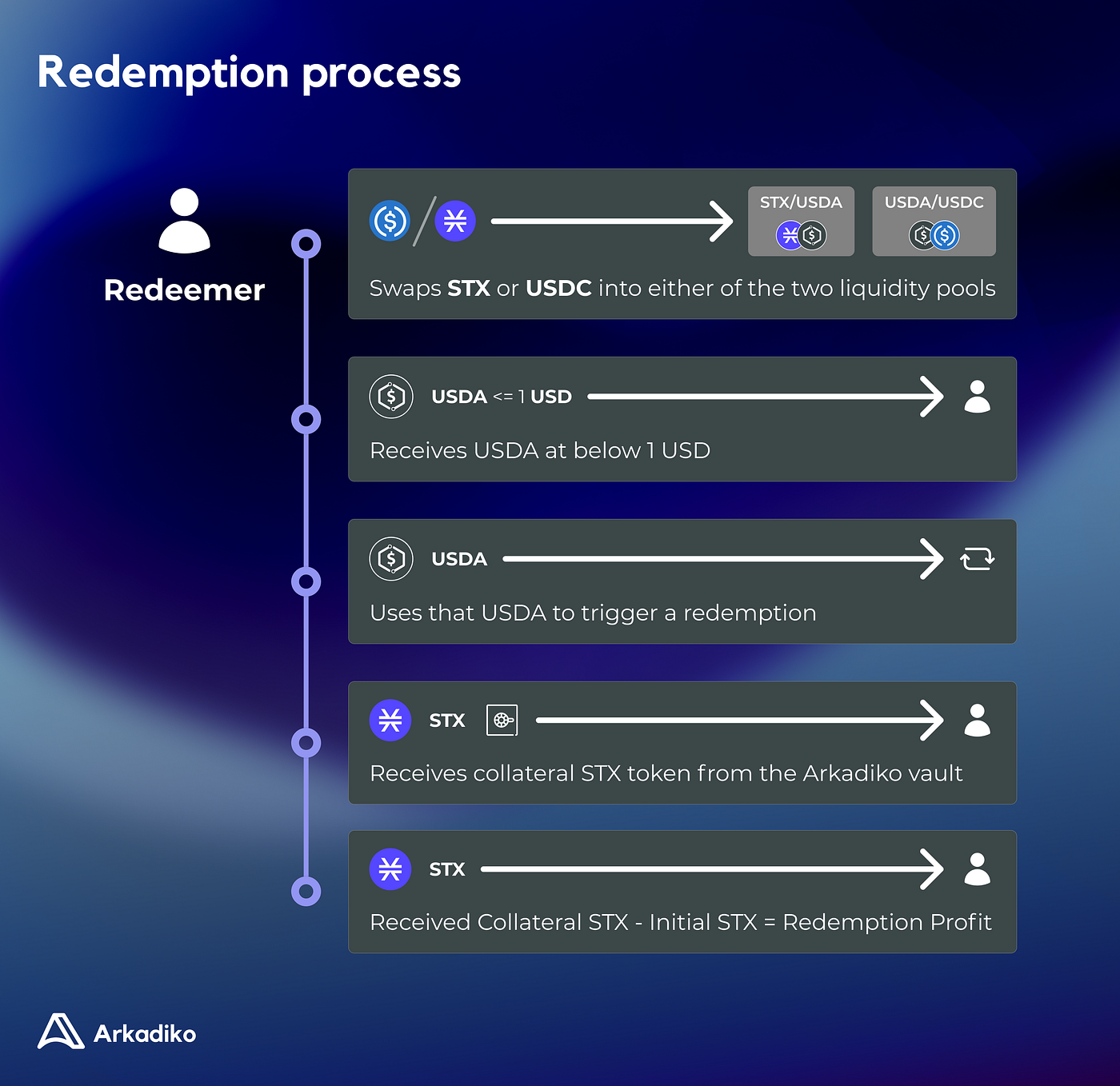
A redemption is the act of using USDA to pay off the debt of an open Arkadiko Vault and receiving equivalent collateral asset tokens in return. This mechanism enables anyone to provide stability to USDA by buying it on the open market under 1 USD and subsequently exchanging it for 1 USD worth of collateral in an open Arkadiko Vault.&#x20;

This provides an economic incentive to perform this type of arbitrage, making sure that USDA does not fall too far in value below 1 USD.

<figure><img src="/files/9Y2vep4eJdhyr9nsqmDf" alt=""><figcaption><p>Redemption decision tree</p></figcaption></figure>

Redemptions are not a new idea and have been successfully used in [Liquity](https://www.liquity.org/) as means to provide peg stability.

**Inner workings**

Arkadiko Vaults are ordered by collateralization ratio which is the ratio between the value of your assets in your Vault and your active debt.

Some Vaults are more healthy than others, meaning that they have more room for their collateral assets to decrease before being flagged for liquidation. In general, our protocol tries to avoid liquidations as much as possible, as they incur a hefty penalty of 10% to the Vault owner’s assets.

Redemptions are permissionless in the sense that anyone can trigger a redemption. The process goes as follows:

1. A redeemer queries the current least healthy Vault and receives back the amount of debt in that Vault.
2. The redeemer then uses USDA to pay off the debt in the Vault.
3. USDA is always valued at 1 USD by the protocol and based on the oracle price of the asset, the correct amount of collateral is taken from the Vault and sent to the redeemer.
4. That Vault has now become more healthy as it has its debt paid off in exchange for collateral assets.

<figure><img src="https://miro.medium.com/v2/resize:fit:1400/1*sDaFt2FgtsoWylIIYOovXQ.png" alt="" height="680" width="700"><figcaption><p>The Redemption process</p></figcaption></figure>

Note that a Redemption can also be partial and does not have to pay off all the debt in the Vault.

Ofcourse, this process of Redemptions is only profitable for the redeemer if he is able to purchase USDA somewhere for less than 1 USD. For example, a redeemer would take 1000 USD worth of STX and uses it to buy USDA. He then triggers a Redemption and receives back more than 1000 USD worth of STX, generating a small profit. It is possible because somewhere, there exists a market, currently in the form of Liquidity Pools where USDA is purchasable for less than 1 USD.

Now in order not to enter a negative spiral of Redemptions, a dynamic Redemption fee is used. This fee starts at 0.5% and increases each time a Redemption takes place. If no Redemptions have taken place for some time, the fee decays slowly back to its initial base fee of 0.5%.

Usually, the knowledge that a Redemption mechanism exists is enough for users to confide in the system and not sell USDA at a serious loss, as they know it will be arbitraged to 1 USD again. So the presence of Redemptions means that they will be needed less often than if there was a non-protocol native way to arbitrage USDA. Redemptions are a soft-peg mechanism which should be needed less often than the hard-peg mechanisms such as buying and selling in liquidity pools.

**Frequently Asked Questions (last updated: April 2024)**

**Is a redemption the same as paying back my debt?**

No, redemptions are a completely separate mechanism. All one has to do to pay back their debt is adjust their vaults debt and collateral.

**Is a redemption the same as a liquidation?**

No, redemptions are a completely separate mechanism. A vault can be liquidated when it becomes unhealthy. In other words, when a vault's collateralisation ratio becomes lower than the liquidation ratio (and thus a liquidation of that vault will occur). A redemption can happen whenever a vault is the least healthy vault in the system for that specific collateral type, as sorted on-chain on contracts (see <https://explorer.hiro.so/txid/SP2C2YFP12AJZB4MABJBAJ55XECVS7E4PMMZ89YZR.arkadiko-vaults-sorted-v1-1?chain=mainnet>).

**How can I avoid being redeemed against?**

The best way to avoid being redeemed against is by maintaining a high collateral ratio relative to the rest of the vaults in the system. Remember: The riskiest vaults (i.e. lowest collateralized vaults) are first in line when a redemption takes place.

**But what happens exactly?**

This is what happens when your vault is redeemed against:

1. Debt Paid Off: A redeemer uses USDA to pay off a portion of your vault’s debt. This happens because your vault was selected as the least healthy vault (collateral-to-debt ratio-wise) for the specific collateral type.
2. Collateral Reduced: The redeemer receives an equivalent amount of your collateral (based on the USDA used) to cover the debt they paid off. This collateral is transferred out of your vault to the redeemer.
3. Remaining Collateral and Debt: After the redemption:

Your vault will have less debt (as the redeemer paid it off), and your collateral will also decrease by the amount given to the redeemer. The remaining collateral and debt will be reflected in your vault. Your vault will not be closed unless all debt is cleared during redemption.

In simpler terms, if your vault is redeemed:

Your USDA debt decreases

Your collateral reduces proportionally

And you retain the remaining collateral after the redeemer has been compensated.

For example: If you had 100 STX collateral and 50 USDA debt, and a redeemer uses 25 USDA to redeem, your vault will now show 75 STX collateral and 25 USDA debt. The redemption process ensures the stability of USDA and incentivizes maintaining healthy vaults. If you want to avoid redemption, you can add more collateral to improve your vault’s health ratio.


# Liquidation Pool

integrated solution for forced liquidations that keep the system healthy

In order to keep USDA sufficiently backed by assets, a mechanism is put into place to liquidate unhealthy Vaults. Once the Liquidation Ratio of a Vault drops below the allowed treshold, the Vault is tagged for liquidation and the assets can be bought at a discount.&#x20;

Since launch, we've democratised liquidations by releasing a way to participate in them without running complex off-chain infrastructure. This integrated solution is called the Liquidation Pool and is an opportunity accessible to anyone who wants to provide USDA as liquidation liquidity.&#x20;

While previous participation in Liquidations required running specialized software, a shared pool of capital is provided where users can deposit USDA. Off-chain scripts are running and able to direct that USDA towards liquidations when they need to happen.

\
An example liquidation involving stSTX:

<figure><img src="/files/3lhcE6HHd62qZR0YIfhk" alt=""><figcaption></figcaption></figure>

This approach has several advantages and benefits for Arkadiko:

1. A pool of capital purposed for liquidations, improving the stability and robustness of USDA in market downturn scenario’s.
2. A single staking use case for USDA with economic fundamentals backing it (liquidation discount)
3. Because of improved stability thanks to 1), we can increase loan-to-value for Vaults, creating more liquidity and extra efficiency.

This pool will work similar to most DeFi pooling mechanisms, where contributions and profits are split pro-rata your pool share. Do be aware that the USDA is used in liquidations, so it is effectively exchanged for discounted assets. When that happens, part of your USDA will turn into STX/stSTX/sBTC. You can then withdraw those tokens, sell them and add the USDA back into the liquidation pool or just enjoy the arbitrage profits. The user is responsible for managing his changing exposure due to Liquidations.&#x20;

We can also only move the USDA for collateral purchases and not for withdrawals to any wallet. So it’s a decentralized and non-custodial solution, in the spirit of Arkadiko.

Arkadiko runs these scripts to help support the mechanism but by no means is this a requirement. Anyone can call a function on the smart contract to trigger the liquidation pool in liquidating Vaults. This means that the liquidation pool works completely decentralized. We just run the scripts as a courtesy towards the community.&#x20;

The Liquidation Pool is currently a beneficiary of DIKO emissions, further increasing the profitability of providing USDA to it.&#x20;

There is a **lock-up mechanism** for the USDA committed.&#x20;

It is not ideal to have the pool fluctuate a lot in how much value is stand-by, we much prefer a stable amount of value being present there. Initial lock-up on USDA deposits is 30 days (4320 blocks). Lockups resets every time you deposit, be aware of this when compounding/redepositing! Epoch period is 5 days and DIKO rewards are distributed at the end of each epoch, pro-rata the USDA at the beginning of the epoch.&#x20;

<br>


# Swap

A permissionless and decentralised way to swap tokens

Arkadiko Swap is our implementation of a Decentralized Exchange on top of the Stacks blockchain.&#x20;

Drawing inspiration from industry titans such as Uniswap and Curve, we have added functionality that enables the swapping of SIP10-tokens through an Automated Market Maker model.&#x20;

Arkadiko Swap only supports liquidity pools with uncorrelated assets. &#x20;

A user that wishes to supply liquidity to such a pool needs to provide STX tokens and USDA tokens of equal value to the pool. He then receives LP (Liquidity Provider) tokens that represent his share of the pool. Trading fees will automatically accrue in the pool and are distributed pro rata the share of each individual that holds LP tokens. Some pools on Arkadiko Swap might be eligible for DIKO emissions, given as incentive to increase the amount of liquidity in the pool.

Arkadiko Swap was the first DEX on the Stacks blockchain. An absolutely crucial component back in the day when no other protocols were available. For liquidity pools with correlated assets, we have chosen to integrate the Bitflow protocol. Swapping in their pools will be made available through the Arkadiko Swap front-end, but will use smart contracts not native to Arkadiko itself.&#x20;

Arkadiko Swap creates opportunities for passive income by providing liquidity to pools and collecting trading fees. On top of regular trading fees, the DIKO Governance token is given as a liquidity mining reward for liquidity providers, greatly increasing the yield and profitability of the capital supplied.&#x20;


# Stake

Arkadiko supports two types of 'Staking':\
\
1\) Staking DIKO for protocol emissions and governance rights in the Security Module.

2\) Staking Arkadiko Swap LP tokens for protocol emissions.&#x20;

1. **Security Module**

DIKO holders have the option to stake their DIKO which converts their DIKO to stDIKO for the duration of the stake. They can always convert back and reclaim their original DIKO. stDIKO gives you a voting weight that can be used to vote on governance proposals.&#x20;

The Security Module serves as a backstop to the protocol. Should a hack or exploit ever create ‘bad debt’ then up to 30% of DIKO tokens staked in the Security Module can be taken to be sold to cover this loss. Staking DIKO in the Security Module comes with the risk of losing up to 30% of your DIKO. In a way, stDIKO holders are providing a type of insurance against protocol losses. The decision to sell DIKO tokens from the Security Module is made through Governance, ensuring that the process follows the same consensus mechanism present throughout the protocol.

By participating in the Security Module by staking stDIKO, a user will be able to receive its fair share of proportionate protocol rewards. These rewards are automatically compounded through a relative price increase of stDIKO vs DIKO. When unstaking, users receive more DIKO than they initially staked, representing the accumulated yield and rewards:

stDIKO/DIKO = (DIKO staked + Rewards accumulated) / DIKO staked

stDIKO is constructed so that it can receive yield from multiple sources. At protocol launch, stDIKO receives rewards from standard protocol emissions. One of the main sources of protocol revenue comes in the form of the stability fee on USDA loans. We have included the option for the Arkadiko DAO to route a percentage of these stability fees to the stDIKO reward pools, effectively adding another source of yield for stakers in the Security Module.

*Unstaking stDIKO*

After staking your DIKO, you receive stDIKO in your wallet. To unstake the stDIKO, you need to go through a cooldown window of 1440 blocks (approximately 10 days). After these 1440 blocks, you have a window of 288 blocks (\~ 2 days) to burn your stDIKO and redeem DIKO.

Summarising:

1. You start the cooldown which is 1440 blocks (\~ 10 days)

2. After the 10 days, you have 288 blocks (two days) to redeem

3. If you fail to redeem within those two days, you need to start the cooldown again

4. **Arkadiko Swap LP token staking**

Those who provide liquidity to liquidity pools on Arkadiko Swap are eligible for liquidity incentives from protocol emissions. We recommend everyone to research and understand the concept of Impermanent Loss before engaging in any type of LP activities.&#x20;

Find all staking opportunities on the [stake page](https://app.arkadiko.finance/stake).&#x20;


# Governance

The DIKO token is first and foremost, a governance token that enables users to weigh in on active proposals in the ArkadikoDAO.&#x20;

Through this method, users actually own the protocol and contributors act in the interest of the DAO, with proper checks and balances in place. Using this approach, Arkadiko can scale and adapt in a decentralized, community-driven way.&#x20;

All smart contract upgrades to the protocol need to pass a mandatory on-chain governance vote. Nobody has ultimate control over the protocol and can change important pieces without explicit approval from the majority of DIKO holders. In order to create a proposal, an address needs to own 0.25% of the circulating DIKO suppy. Every proposal needs at least 5% of circulating DIKO supply to vote to reach its quorum. A proposal passes if more than 50% of votes are *FOR*.&#x20;

Arkadiko is proud of the way it has been operating for the past few years, actively involving the community in every important decision. A typical protocol upgrade goes through the following phases:

1. Core contributors identify an issue or improvement internally and discuss a solution or implementation.&#x20;
2. The analysed subject matter is presented in the [Arkadiko discord](https://discord.gg/7UWJjtx2) using a dedicated channel. There is discussion and feedback about the issue at hand. This is concluded with an AIP (Arkadiko Improvement Proposal).&#x20;
3. The AIP is created on-chain by a DAO member. This includes the relevant smart contract changes that need to happen.&#x20;
4. Voting is started on the AIP.
5. Voting concludes.
6. The AIP becomes part of the protocol and the smart contract change is locked in.

Find historic and active proposal under the [Governance tab](https://app.arkadiko.finance/governance) of the Arkadiko app.


# Tokenomics

Token distribution of the Arkadiko token

<figure><img src="/files/ucJS2hKPuIDnJsppItXy" alt="" width="350"><figcaption><p>DIKO Tokenomics</p></figcaption></figure>

* **100 000 000** tokens minted.
  * **21 % Team** -- 4 year vesting with monthly unlocks after a 6 month cliff.
  * **12 % Strategic raise** -- Small private sale to key investors with clear value add.&#x20;

    Same vesting as team tokens.&#x20;
  * **17 % ArkadikoDAO Treasury** -- Locked tokens held by the DAO. Allocated to use cases that clearly benefit the protocol. Catches future token needs that can not be conceived right now.&#x20;
  * **50%  Ecosystem reward pool** -- Arkadiko tokens are emitted according to the [emission schedule](/diko-token/emissions) as an incentive for users to provide liquidity to the protocol.

DIKO is the governance token for ArkadikoDAO.&#x20;

DIKO serves as the Governance token of the Arkadiko Protocol. It is the main coordination mechanism that we use within the ecosystem. The DIKO token will allow holders to have a say in important decisions that the ArkadikoDAO proposes. It will also capture yield from several sources, starting with standard protocol emissions but possibly extending to protocol fees.&#x20;

Prior to the launch of the protocol on 21 October 2021, Arkadiko secured funding to develop the platform through a strategic raise with several key ecosystem partners and funds. 12% of the DIKO supply was sold at $0.25 / DIKO. Sale participants had a 6 month cliff, followed by linear monthly unlocks for the next 4 years. The team tokens are following the exact same vesting schedule.&#x20;

The rest of the DIKO supply is being distributed through protocol emissions. The final chunk of DIKO supply is allocated to the ArkadikoDAO, to be reserved for future use.&#x20;


# Emissions

How and when do new DIKO tokens enter circulating supply?

Arkadiko releases a pre-set amount of DIKO rewards every two weeks, which is the length of a proof of transfer cycle.&#x20;

Initially, the rate at which new DIKO are rewarded the protocol contributors is very high. Every two week, the amount of DIKO released decreases by 2 %.

After five years, the protocol targets a 2% yearly inflation rate.&#x20;

<figure><img src="/files/Gwvz7OwmQXTMxtW3gmQx" alt=""><figcaption></figcaption></figure>

**Reward Sinks**

From the total amount of weekly emissions, several Reward sinks are chosen to which these new tokens will flow, decided by governance according to the protocols needs.

DIKO emissions should be carefully crafted to incentivize the right kind of liquidity in the Stacks DeFi ecosystem.&#x20;

Current reward sinks are:\
\
stDIKO: 20%&#x20;

DIKO-USDA: 25%

STX-USDA 35%&#x20;

STX-DIKO: 10%

Liquidation Pool: 10%

Governance regularly revises the reward sinks to make sure they are still maximally benefiting the protocol. An initial prognosis was created as the start of the protocol in the following graphic, but due to changes in reward weights, is no longer completely accurate:\ <br>

<figure><img src="/files/c4h84cB7beq3dXnZuI5t" alt=""><figcaption><p>Forecast with initial starting reward weights</p></figcaption></figure>


# Introduction

### Overview <a href="#overview" id="overview"></a>

Automate your smart contracts using **Arkadiko Keepers**, the decentralized and reliable smart contract automation service. Relying on Keepers will help you get to market faster and automate tasks by offloading on-chain automation logic to our Keepers.

<figure><img src="/files/mQLT0dHjT12ypLCyXzPt" alt=""><figcaption><p>The Arkadiko Keepers UI on https://keepersapp.arkadiko.finance</p></figcaption></figure>

### Supported Networks and Cost <a href="#supported-networks-and-cost" id="supported-networks-and-cost"></a>

Arkadiko Keepers are supported on the Stacks blockchain. Deploy any type of job (as a Clarity smart contract) you want to run based on a custom computation, a certain block height, or any other on-chain activity within 15 minutes!

### Using Arkadiko Keepers <a href="#using-chainlink-keepers" id="using-chainlink-keepers"></a>

In order to get started, please read the [Running a Job](/keepers/running-a-job) section.


# Running a Job

In order to create a job, you will need to deploy a **Clarity smart contract** that is conform with the Arkadiko Keeper Automation trait (`arkadiko-automation-trait-v1`, TODO: add mainnet link).&#x20;

High-level, you can automate your smart contract using the following steps:

1. Make your contract **Keepers-compatible** so the Keepers Network knows how to check if your contract should be called, and what to do when calling your contract.
2. **Fund your address in the Arkadiko Job Registry** with sufficient DIKO and STX (we recommend about 2000 DIKO and 15 STX). The DIKO and STX will be credited each time your smart contract runs. Currently, one smart contract execution costs 10 DIKO as a reward for the keeper and 0.001 STX as a reward for the gas fee.
3. After your job is registered and funded, you can **manage** it (e.g. enable/disable) through the job registry smart contract.

You can read a small tutorial and example use case in the [Keepers-compatible contracts](/keepers/keepers-compatible-contracts) section.


# Funding your account

Our UI on <https://keepersapp.arkadiko.finance/> makes it easy to fund your account with DIKO and STX.&#x20;

Simply connect your wallet and you will see the screen below that allows you to credit or debit your account.&#x20;

<figure><img src="/files/cvw7jIaogsUi6UGkNupC" alt=""><figcaption><p>Credit or debit your Arkadiko Keepers account</p></figcaption></figure>

Alternatively, you can fund your account manually by sending STX and DIKO through the `credit-account` public function.<br>


# Managing Jobs

Our UI on <https://keepersapp.arkadiko.finance/> makes it easy to manage your Arkadiko Jobs.

You can easily register your job which will be displayed if it is implemented with the `arkadiko-automation-trait-v1`&#x20;

<figure><img src="/files/yl15hWnkLpligBwnD8jH" alt=""><figcaption></figcaption></figure>

Alternatively, you can register a new automation job through the `register-job` function.<br>


# Keepers-compatible contracts

### Overview <a href="#overview" id="overview"></a>

Learn how to make smart contracts **Keepers-compatible** with the `arkadiko-automation-trait-v1` trait and its functions.

### Example Contract <a href="#example-contract" id="example-contract"></a>

Keepers-compatible contracts must meet the following requirements:

* Implement trait `arkadiko-automation-trait-v1`. You can refer to the Arkadiko Contracts on GitHub to find the trait interface.
* The automation trait has three functions that need to be implemented: `initialize`, `check-job` and `run-job`
* Include a read-only `check-job` function that contains the logic that will be executed off-chain to see if `run-job` should be executed. The `run-job` function can use on-chain data from any other Clarity smart contract, including use of the `at-block` function to access historical data.
* Include a public `run-job` function that will be executed on-chain when `check-job` returns `(ok true)`.

After you register the contract as an Arkadiko Job, the Keepers Network simulates the `check-job` read-only function off-chain during every block to determine if the job needs to run. When `check-job` returns `(ok true)`, the Keepers Network calls `run-job` on-chain and charges 10 DIKO plus the STX gas fee from your account. This cycle repeats until the job is cancelled or runs out of funding.

```
;; Add DIKO to liquidation pool every 1008 blocks
(impl-trait .arkadiko-automation-trait-v1.automation-trait)

(define-public (initialize)
  (ok true)
)

(define-read-only (check-job)
  (let (
    (end-epoch-block (unwrap-panic (contract-call? 'ST1PQHQKV0RJXZFY1DGX8MNSNYVE3VGZJSRTPGZGM.arkadiko-liquidation-rewards-diko-v1-1 get-end-epoch-block)))
  )
    (asserts! (>= block-height end-epoch-block) (ok false))

    (ok true)
  )
)

(define-public (run-job)
  (begin
    (asserts! (unwrap-panic (check-job)) (ok false))

    ;; TODO - Update for mainnet
    (unwrap-panic (contract-call? 'ST1PQHQKV0RJXZFY1DGX8MNSNYVE3VGZJSRTPGZGM.arkadiko-liquidation-rewards-diko-v1-1 add-rewards 'ST1PQHQKV0RJXZFY1DGX8MNSNYVE3VGZJSRTPGZGM.arkadiko-liquidation-rewards-v1-2))
    
    (ok true)
  )
)
```

In the above example, we would like to add an amount of DIKO tokens to the Arkadiko liquidation pool which is used as rewards for people depositing USDA. More information about the liquidation pool can be found [here](/protocol/liquidation-pool). Let's analyze the above lines of code.

On line 2, we import the arkadiko automation trait that will require us to implement the three required methods: initialize, check-job and run-job. In this case, we don't need any initialization logic (which you need to execute yourself on deployment), so we simply return (ok true).

The **check-job read-only function** will call an Arkadiko read-only function to get the `end-epoch-block`. Or in other words, we get the block height at which we should add new DIKO to the liquidation rewards. Alternatively, we could have also written custom logic in this smart contract to keep the last block execution and execute it every 1008 blocks. When the current `block-height` is greater or equal to the `end-epoch-block` height, we should return `(ok true)`. Otherwise, we return `(ok false)`.

> **IMPORTANT**: Your check-job function should never return an error (e.g. (err false)), since that would make the whole execution process fail. Simply return (ok true) or (ok false)

The **run-job public function** simply executes the transfer of DIKO through a liquidation rewards contract and returns (ok true). Always end your execution with an error code or an ok code.

#### Best practices <a href="#best-practices" id="best-practices"></a>

**Trigger ONLY when conditions are met**

Some actions must be performed only when specific conditions are met. Check all of the preconditions within `check-job` and `run-job` as well to ensure that state change occurs only when necessary.In this pattern, it is undesirable for the state change to occur until the next time the Arkadiko Job is checked by the network and the conditions are met. It is a best practice to stop any state change or effects by performing the same checks or similar checks that you use in `check-job`. These checks validate the conditions before doing the work.For example, if you have a contract where you create a block-height based timer in `check-job` that is designed to start a transfer at a specific time, validate the condition to ensure third-party calls to your `run-job` function do not start the transfer at a different block height.

**Trigger ONLY when data is verified**

Some actions must be performed using data you intend to use. Validated that the `run-job` function is allowed before execution.For example, if you have a `run-job` that funds a wallet, ensure you have a list of permissable addresses to compare against to prevent third-party calling your function to send money to their address.

**When triggering is not harmful**

Sometimes actions must be performed when conditions are met, but performing actions when conditions are not met is still acceptable. Condition checks within `run-job` might not be required, but it can still be a good practice to short circuit expensive and unnecessary on-chain processing when it is not required.It might be desirable to call `run-job` when the `check-job` conditions haven't yet been tested by Arkadiko Keepers, so any specific checks that you perform are entirely use case specific.

**Test your contract**

As with all smart contract testing, it is important to test the boundaries of your smart contract in order to ensure it operates as intended. Similarly, it is important to make sure your Keepers-compatible contract operates within the parameters of the Job Registry.Test all of your mission-critical contracts, and stress-test the contract to confirm the performance and correct operation of your use case under load and adversarial conditions. The Arkadiko Keeper Network will continue to operate under stress, but so should your contract.<br>

### &#x20;<a href="#best-practices" id="best-practices"></a>


# Disclaimer

The information provided on Arkadiko's website and mobile application is for general informational purposes only and should not be viewed as financial advice. All content is offered in good faith; however, Arkadiko makes no representation or warranty of any kind regarding its accuracy, adequacy, or completeness. Investments in cryptocurrencies and DeFi projects through Arkadiko involve high risks, including the potential loss of principal, and may not be suitable for all investors. It is vital for users to conduct their own due diligence and consult with financial advisors before making investment decisions. Arkadiko bears no responsibility for any losses or damages arising from the use of or reliance on the information provided, including information from third-party sources.


# Restricted countries

Residents of the following countries are restricted from using the Arkadiko app:

* Belarus
* Cuba
* Democratic People's Republic of Korea (DPRK)
* Democratic Republic of the Congo
* Iran
* Iraq
* Lebanon
* Libya
* Mali
* Myanmar
* Nicaragua
* Russia
* Somalia
* South Sudan
* Sudan
* Syria
* United States of America
* Autonomous Republic of Crimea
* Donetsk Oblast in Ukraine
* Luhansk Oblast in Ukraine


# Contracts

\
BEWARE: When in doubt, always verify the contract address of the token or smart contract you are interacting with. There may be multiple contracts with the name USDA and/or DIKO in rotation. The only real ones are listed below:

* DIKO: ​<https://explorer.hiro.so/txid/SP2C2YFP12AJZB4MABJBAJ55XECVS7E4PMMZ89YZR.arkadiko-token?chain=mainnet>
* USDA:\
  &#x20;​<https://explorer.hiro.so/txid/SP2C2YFP12AJZB4MABJBAJ55XECVS7E4PMMZ89YZR.usda-token?chain=mainnet>

The Arkadiko DAO address is SP2C2YFP12AJZB4MABJBAJ55XECVS7E4PMMZ89YZR. Any smart contract deployed to that address can be trusted as deployed by the Arkadiko DAO.


# AMM API Docs

The Arkadiko AMM has a public API that can be used for integrations. This page shows documentation on the endpoints and how they can be used

## /api/v1/tickers

{% embed url="<https://arkadiko-api.herokuapp.com/api/v1/tickers>" %}

The `/api/v1/tickers` API endpoint shows all trading pairs that are listed on the Arkadiko AMM. The endpoint returns a JSON with the following fields

| Name               | Data Type | Description                                                                                                                                                                         |
| ------------------ | --------- | ----------------------------------------------------------------------------------------------------------------------------------------------------------------------------------- |
| ticker\_id         | string    | <p>Identifier of a ticker with delimiter to separate base/target, eg. BTC\_ETH</p><p>(Contract address for DEX)</p>                                                                 |
| base\_currency     | string    | Symbol/Currency code/Contract Address of a the base cryptoasset, eg. BTC (Contract address for DEX)                                                                                 |
| target\_currency   | string    | Symbol/Currency code/Contract Address of the target cryptoasset, eg. ETH (Contract address for DEX)                                                                                 |
| pool\_id           | string    | pool/ pair address or unique ID (Mandatory for DEX)                                                                                                                                 |
| last\_price        | decimal   | <p>Last transacted price of base currency based on given target currency (unit in base or target)<br><br></p><p>eg.</p><p>X = ?</p><p>1 base = X target</p><p>X base = 1 target</p> |
| base\_volume       | decimal   | 24 hour trading volume for the pair (unit in base)                                                                                                                                  |
| target\_volume     | decimal   | 24 hour trading volume for the pair (unit in target)                                                                                                                                |
| pool\_id           | string    | pool/pair address or unique ID (Mandatory for DEX)                                                                                                                                  |
| liquidity\_in\_usd | decimal   | Pool liquidity in USD                                                                                                                                                               |
| bid                | decimal   | Current highest bid price                                                                                                                                                           |
| ask                | decimal   | Current lowest ask price                                                                                                                                                            |
| high               | decimal   | Rolling 24-hours highest transaction price                                                                                                                                          |
| low                | decimal   | Rolling 24-hours lowest transaction price                                                                                                                                           |

## /api/v1/pools/:id

{% embed url="<https://arkadiko-api.herokuapp.com/api/v1/pools/2>" %}

Given a pool ID (e.g. 1, 2,3 etc), returns information about the pool and its assets. The endpoint returns a JSON with the following fields:

| Name              | Data Type | Description                                                 |
| ----------------- | --------- | ----------------------------------------------------------- |
| id                | string    | The ID of the entry in the DB                               |
| token\_x\_name    | string    | The name of token X in the pair                             |
| token\_y\_name    | integer   |                                                             |
| token\_x\_address | string    | Start time from which to query historical trades from       |
| token\_y\_address | string    | End time for historical trades query                        |
| token\_x\_id      | string    | The ID of token X of the entry in the DB                    |
| token\_y\_id      | string    | The ID of token Y of the entry in the DB                    |
| balance\_x        | string    | The balance of token X in the pool (denominated in token X) |
| balance\_y        | string    | The balance of token Y in the pool (denominated in token Y) |
| enabled           | boolean   | Whether pair is enabled in the AMM or not                   |

## /api/v1/pools/:id/prices

{% embed url="<https://arkadiko-api.herokuapp.com/api/v1/pools/2/prices>" %}

Given a pool ID (e.g. 1, 2, 3 etc), returns all historical prices of a pair.


# Links

🌐 Visit us at [Arkadiko.finance](https://www.arkadiko.finance/) 🌐

💬 Chat with us on [Discord](https://discord.gg/Sq8qaMyfkS) 💬

📚 Read our documentation on [Gitbook](https://docs.arkadiko.finance/) 📚

🐦 Find us on Twitter — [@ArkadikoFinance](https://www.twitter.com/ArkadikoFinance) 🐦

📰 Read our Medium - [@ArkadikoFinance](https://medium.com/@arkadikofinance) 📰


# Blog

#### [Arkadiko 2.0 — Testnet](https://medium.com/@arkadikofinance/arkadiko-2-0-testnet-ad32f4f8246b?source=your_stories_page-------------------------------------)

#### [It is finally here Arkadians, the Arkadiko 2.0 Testnet!](https://medium.com/@arkadikofinance/arkadiko-2-0-testnet-ad32f4f8246b?source=your_stories_page-------------------------------------)

#### [Arkadiko’s Great Migration](https://medium.com/@arkadikofinance/arkadikos-great-migration-195faaf24a21?source=your_stories_page-------------------------------------)

#### [Explaining Arkadiko 2.0: Redemptions](https://medium.com/@arkadikofinance/explaining-arkadiko-2-0-redemptions-d37d2f73c994?source=your_stories_page-------------------------------------)

#### [Arkadiko 2024 Roadmap](https://medium.com/@arkadikofinance/arkadiko-2024-roadmap-e986202b2e7f?source=your_stories_page-------------------------------------)

#### [Arkadiko Roadmap 2023](https://medium.com/@arkadikofinance/arkadiko-roadmap-2023-14eea6adff51?source=your_stories_page-------------------------------------)

#### [Release the StableSwap!](https://medium.com/@arkadikofinance/release-the-stableswap-3d453e7b5fca?source=your_stories_page-------------------------------------)

#### [Arkadroids Distribution](https://medium.com/@arkadikofinance/arkadroids-distribution-bc032b2a45f2?source=your_stories_page-------------------------------------)

#### [Arkadiko Summer Update](https://medium.com/@arkadikofinance/arkadiko-summer-update-587f7ffbc1e9?source=your_stories_page-------------------------------------)

#### [Arkadiko Liquidation Pool](https://medium.com/coinmonks/arkadiko-liquidation-pool-9a2e98bb6ee3?source=your_stories_page-------------------------------------)

#### [The USDA Focus](https://medium.com/@arkadikofinance/the-usda-focus-ad0eb0fd54be?source=your_stories_page-------------------------------------)

#### [Reflecting on Arkadiko](https://medium.com/@arkadikofinance/reflecting-on-arkadiko-3460d513bfa4?source=your_stories_page-------------------------------------)

#### [Arkadiko <> Lydian Partnership (🤝,🤝)](https://medium.com/@arkadikofinance/arkadiko-lydian-partnership-b3613549565c?source=your_stories_page-------------------------------------)

#### [Arkadiko — Q4 2021](https://medium.com/@arkadikofinance/arkadiko-q4-2021-81252a1e6325?source=your_stories_page-------------------------------------)

#### [Welshcorgicoin Listing](https://medium.com/@arkadikofinance/welshcorgicoin-listing-fa7d5c903d86?source=your_stories_page-------------------------------------)

#### [Arkadiko xBTC Listing](https://medium.com/@arkadikofinance/arkadiko-xbtc-listing-2896b74c03a2?source=your_stories_page-------------------------------------)

#### [Arkadiko Oracle Glitch Aftermath](https://medium.com/@arkadikofinance/arkadiko-oracle-glitch-aftermath-23dc1b742513?source=your_stories_page-------------------------------------)

#### [Arkadiko Shades NFT](https://medium.com/@arkadikofinance/arkadiko-shades-nft-aad62174f720?source=your_stories_page-------------------------------------)

#### [Arkadiko Swap Detailed Post Mortem](https://medium.com/@arkadikofinance/arkadiko-swap-detailed-post-mortem-b79f8a68f922?source=your_stories_page-------------------------------------)

#### [Arkadiko Swap Post Mortem](https://medium.com/@arkadikofinance/arkadiko-swap-post-mortem-f38cef95ff28?source=your_stories_page-------------------------------------)

#### [Arkadiko Post-Launch write-up](https://medium.com/@arkadikofinance/arkadiko-post-launch-write-up-9268722a1c86?source=your_stories_page-------------------------------------)

#### [Arkadiko Launch Information](https://medium.com/@arkadikofinance/arkadiko-launch-information-69a8d2a33456?source=your_stories_page-------------------------------------)

#### [Arkadiko — Strategic Raise](https://medium.com/@arkadikofinance/arkadiko-strategic-raise-d01bc19a0b00?source=your_stories_page-------------------------------------)

#### [Arkadiko Products — USDA](https://medium.com/@arkadikofinance/arkadiko-products-usda-80fbff5b4ef0?source=your_stories_page-------------------------------------)

#### [The Arkadiko Vision](https://medium.com/@arkadikofinance/the-arkadiko-vision-ab2340bf0b2b?source=your_stories_page-------------------------------------)

#### [A brief history of Stablecoins](https://medium.com/@arkadikofinance/a-brief-history-of-stablecoins-a19f7880f839?source=your_stories_page-------------------------------------)

#### [Gearing up for Testnet ⚙️](https://medium.com/@arkadikofinance/gearing-up-for-testnet-%EF%B8%8F-fd4a5b54fc00?source=your_stories_page-------------------------------------)

#### [Digging deeper: xUSD and DIKO](https://medium.com/@arkadikofinance/digging-deeper-xusd-and-diko-1a824ff3b8d4?source=your_stories_page-------------------------------------)

#### [Arkadiko Protocol — Hello World 👋](https://medium.com/@arkadikofinance/arkadiko-protocol-hello-world-e3932293dafd?source=your_stories_page-------------------------------------)<br>


# How-to Guides

A couple of guides are available to help you get started with Arkadiko:

[Getting started with Arkadiko](/additional-resources/how-to-guides/getting-started-with-arkadiko)

[Setting up the Leather wallet to interact with Arkadiko](/additional-resources/how-to-guides/setting-up-the-leather-wallet-to-interact-with-arkadiko)

[Earn yield on STX and USDA with Arkadiko](/additional-resources/how-to-guides/earn-yield-on-stx-and-usda-with-arkadiko)


# Getting started with Arkadiko

To use the Arkadiko protocol you need the following dependencies:

1\) [The Leather Wallet ](https://leather.io)

This browser extension allows you to store STX and SIP010 tokens. You will also be able to send tokens and sign transactions with smart contracts.&#x20;

2\) An initial amount of STX tokens.

Arkadiko is a liquidity protocol that uses STX as its primary source of collateral. In order to mint USDA, you'll need STX tokens. You will also need a much smaller amount of STX just to be able to interact with smart contracts, as there is a very small fee involved in each transaction.&#x20;


# Setting up the Leather Wallet to interact with Arkadiko

Now that you have all the [dependencies](/additional-resources/how-to-guides/getting-started-with-arkadiko), you can go to [app.arkadiko.finance](https://app.arkadiko.finance) and connect your wallet to the Arkadiko front-end . The website will now be able to read your Stacks wallet data such as its address and the amount of tokens it holds.&#x20;

You will use the Stacks wallet to sign transactions and authorize movement of your tokens within the protocol. Remember to carefully back-up the seed you use to initialize the wallet, we do not want you to lose access to your tokens !


# Earn yield on STX and USDA with Arkadiko

On this page, we'll discuss the current opportunities for USDA to be used in the Stacks DeFi ecosystem:

1. Using USDA as a component for providing liquidity to volatile swap pairs:

   \
   There are liquidity pools for STX/USDA, DIKO/USDA, xBTC/USDA and ALEX/USDA, all of which earn trading fees and DIKO incentives as reward for providing liquidity. \
   Note that this does expose you to different asset types and their price evolutions. You might also suffer from impermanent loss. Please make sure you do your research and decide if the risk is worth it.<br>
2. Deposit USDA in the Liquidation Pool to earn DIKO and discounted collateral.

   \
   Read more about this opportunity:[ Liquidation Pool](/protocol/liquidation-pool)

   \
   Go here: [https://app.arkadiko.finance/liquidation](https://app.arkadiko.finance/liquidations)\ <br>
3. SOON: Deposit USDA in the  StableSwap on Bitflow.&#x20;

   \
   You can provide liquidity in StableSwap liquidity pool on Bitflow and stake the resulting LP token on Arkadiko stake page.\
   \
   View all available opportunities and DIKO APR's here:\
   \
   <https://app.arkadiko.finance/stake>


